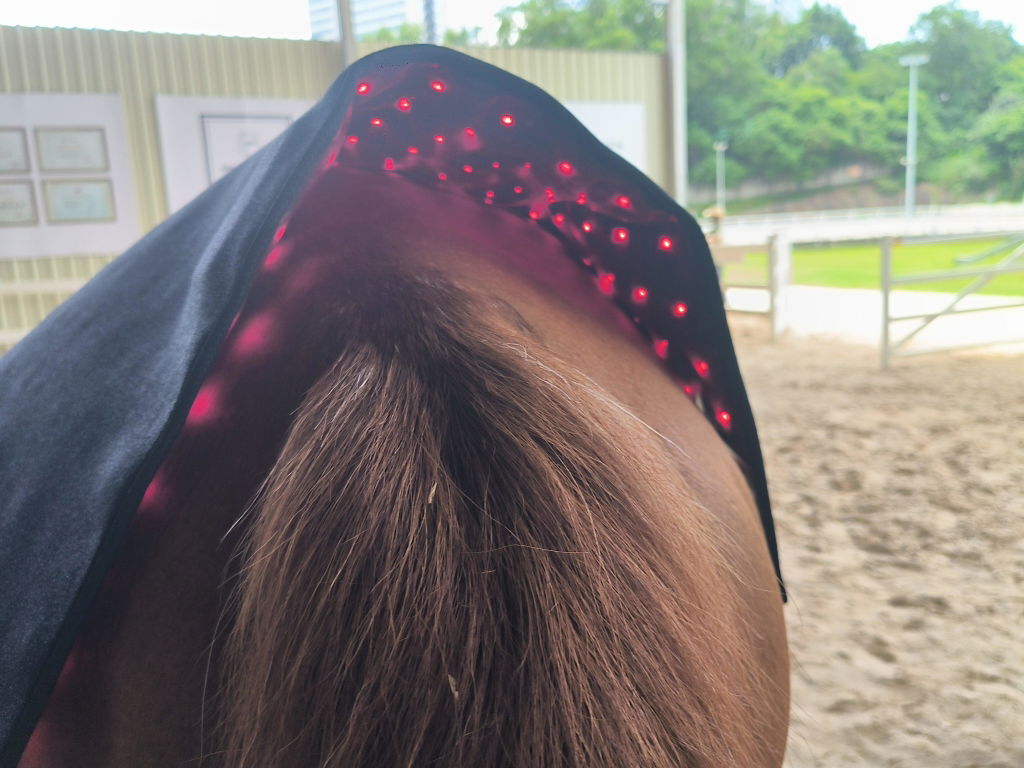
Equine Recovery Light Therapy: The Complete Application Guide for Post-Training, Post-Competition, and Daily Performance Recovery
Performance Recovery Application
Why the 60-90 minute window after exercise is the most important time you'll touch your horse — and how red light therapy fits into a complete recovery system that includes hydration, ice, massage, and rest. A practical guide for serious horse owners who train regularly.
Recovery is what separates good training programs from great ones. The work in the saddle creates the stimulus for fitness gains, but the adaptation actually happens in the hours and days that follow — when muscle micro-damage repairs, soft tissue remodels, energy stores rebuild, and the nervous system consolidates the learning. A horse that recovers well from each session can absorb more training volume, maintain higher intensity across a season, and stay sound across a longer competitive career.

This is where equine recovery light therapy fits in. Red light therapy isn't a recovery silver bullet — no single modality is — but it's one of the more useful tools in a well-designed recovery system, particularly when applied in the right window with the right protocol for the work the horse just did. This guide covers exactly how to integrate red light therapy horse recovery into post-training and post-competition routines, which body zones to prioritize, how recovery applications differ from injury treatment, and how PBM stacks with ice, massage, and rest for the cumulative effect that elite training programs depend on.
Why Equine Recovery Light Therapy Matters for Athletic Horses
A horse that performs at training level — daily flatwork, jumping schools, dressage drilling, or competition — accumulates muscle micro-damage, soft-tissue stress, and metabolic byproducts that need time to clear. Red light therapy supports the cellular processes that handle this clearing, helping the horse arrive at the next training session more recovered, more capable, and less compromised by carryover fatigue from the last session.
window post-exercise
muscle group
during training cycle
benefit visible
The 4 Recovery Time Windows: When PBM Has the Most Impact
Equine recovery light therapy doesn't deliver equal value at every moment. The biological state of muscle tissue, circulation patterns, and inflammatory signaling all change in the hours after exercise — and the value of PBM intervention changes with them. Understanding the four recovery windows helps you allocate treatment time where it produces the most benefit.
Golden Recovery Window
(0–90 min Post-Work)
Local circulation is elevated, mitochondrial activity is at peak, and muscle tissue is most responsive to PBM intervention. This is when red light therapy has the largest single-session impact on recovery markers.
Acute Recovery
(2–8 hours Post-Work)
Inflammatory cytokines are at peak signaling, delayed-onset muscle soreness (DOMS) processes are active. Red light therapy horse recovery in this window supports the modulation of inflammation toward resolution.
Overnight Recovery
(8–24 hours Post-Work)
Muscle adaptation processes peak during sleep and rest periods. Treatment in this window supports the cellular repair and remodeling that occurs during the body's natural recovery cycle.
Maintenance Recovery
(24+ hours Post-Work)
Beyond 24 hours, the recovery-acceleration benefit reduces but PBM still provides value for ongoing maintenance, chronic stress point management, and supporting next-session preparation.
5 Recovery Scenarios with Specific Equine Recovery Light Therapy Protocols
Different recovery situations need different protocols. The post-flat-work recovery routine isn't the same as post-cross-country, post-trailer, or post-illness recovery. Below are the five scenarios most owners and trainers encounter, with specific protocols for each.
Post-Training Daily Recovery
Daily Use WorkhorseThe most common application: standard daily training session followed by routine recovery support. Post-training recovery for horses focuses on the muscle groups worked, with emphasis on the back and hindquarters that bear the rider's weight and provide the engine for forward movement.
Post-Competition Recovery
Show Day RoutineAfter a class, round, or test, the horse needs more comprehensive recovery than a daily session requires. Post-competition recovery uses longer protocols across more body zones, particularly when classes are stacked across multiple days. The goal: arrive at tomorrow's class as fresh as possible.
Post-Trailer / Travel Recovery
Travel StressTrailering — even short trips — creates a specific recovery need: continuous bracing in the trailer fatigues stabilizer muscles in the back, hindquarters, and lower legs. Long-distance hauls add dehydration stress and immobility-related stiffness. PBM treatment after arrival helps reset these patterns before the next work session.
Post-Layoff Return-to-Work
Conditioning BuildupBringing a horse back from layoff (illness, vacation, winter break, surgery recovery) requires gradual re-introduction of work. The first 2-4 weeks back, muscles fatigue faster, soreness develops earlier, and recovery takes longer. PBM during this transition supports faster muscle adaptation as conditioning rebuilds.
Senior Horse Maintenance
Career ExtensionOlder competition horses (typically 14+) benefit from more comprehensive daily recovery than younger horses. Recovery slows naturally with age, joint stress points become more prominent, and the cumulative wear of years of training shows up as morning stiffness or post-work soreness. PBM supports career extension by addressing these patterns daily.
Heavy Cross-Country / Endurance Recovery
High-Intensity RecoveryCross-country phases of three-day eventing, endurance racing, and similar high-intensity efforts create the deepest muscle and metabolic fatigue. Recovery from these efforts requires the longest, most thorough PBM protocols, typically combined with cold therapy and massage in a multi-modal approach.
Body Zone Map: Where to Treat for Different Disciplines
Different equestrian disciplines stress different muscle groups. Optimizing horse muscle recovery means matching treatment time to where the horse actually worked, not blanket coverage. Below is the body zone breakdown by discipline.
Discipline-Specific Recovery Zones
Where to focus equine recovery light therapy time based on the work just performed.
(Topline)
(Engine)
(Tendons / Ligaments)
Integration with the Training Cycle: A Sample Week
Equine performance recovery isn't about treating one session in isolation. It's about how PBM integrates across a training week. Below is a sample structure showing how recovery light therapy fits into a typical competition-program training cycle.
PBM Integration Across a 7-Day Training Cycle
Recovery from weekend competition or hard work. 10-min PBM on back and hindquarters. Maintenance only.
15-min PBM post-ride: back (5 min), hindquarters (5 min), hocks (5 min). Standard daily protocol.
25-min PBM post-ride: full body recovery. Add evening 10-min on hocks and stifles. Longest protocol of the week.
15-min PBM: focus on areas that worked hardest yesterday. Lighter day for the horse but recovery support continues.
8-10 min PBM pre-ride on back and major muscle groups (warm-up application). Post-ride: 10-min light recovery.
Pre-warm-up: 5-min PBM on stiff areas. Post-class: 25-min recovery PBM. Evening: 10-min on chronic stress points.
15-min PBM if available — supports next-week training quality. Skip if horse needs full mental rest.
Recovery Stack: How PBM Combines with Ice, Massage, and Other Modalities
Equine recovery light therapy is most effective when it's part of a system, not used alone. Below are the most effective combinations with other recovery modalities.
PBM + Ice Therapy
Cold therapy in the first 24 hours after intense work reduces acute inflammation; PBM in the same window supports cellular recovery. The combination is more effective than either alone for high-intensity sessions.
PBM + Therapeutic Massage
Massage handles mechanical tissue work — adhesions, trigger points, fascial restrictions. PBM operates at cellular level. Used together, they address tissue health from multiple angles.
PBM + Stretching / Mobility Work
Mobility work moves joints through full range; PBM supports tissue recovery between sessions. Particularly effective for senior horses and horses with known stiffness patterns.
PBM + Hydrotherapy
Cold water hosing or aqua treadmill work reduces inflammation and provides mild resistance training. PBM after hydrotherapy supports the recovery the cold work has begun.
PBM + Acupuncture / Chiropractic
After veterinary acupuncture or chiropractic adjustment, PBM supports the tissue that was treated. Many veterinarians who practice integrative medicine specifically recommend PBM follow-up.
PBM Standalone (Routine Use)
For routine daily use without other modalities — many owners simply add PBM to their existing post-work routine without changing anything else. Effective even as a single addition.
PBM Doesn't Compensate for Bad Programming
Equine recovery light therapy supports recovery from training that's appropriately matched to the horse's fitness level. It does not compensate for over-training, inadequate rest days, poor saddle fit, biomechanical issues, dental problems, nutritional deficits, or training that's beyond the horse's current capability. If a horse is showing chronic recovery struggles despite consistent PBM use, the issue isn't the recovery modality — it's something upstream that's creating the recovery deficit. Address the root cause first; PBM is a tool that amplifies good training programs, not one that rescues bad ones.
When Recovery Issues Mean You Need More Than PBM
Sometimes a horse's recovery struggles are signaling a problem that's beyond what any recovery modality can address. Watch for these warning signs that indicate something else is going on:
Persistent post-work soreness despite consistent recovery work — if the horse is consistently sore the day after work despite proper cool-down, hydration, and PBM use, there may be a saddle fit issue, dental problem, or biomechanical asymmetry creating compensation patterns that recovery alone won't fix. Time for a thorough vet evaluation.
Lameness or asymmetric movement that develops after work — this is not normal training-related fatigue. Lameness needs veterinary diagnosis; PBM applied to a lameness without diagnosis can mask symptoms while the underlying problem worsens.
Behavioral changes around the work — pinning ears at saddling, hesitation under saddle, changed mouth on the bit, reluctance to move forward. These often indicate physical pain that's beyond what recovery support can solve.
Performance decline despite training — if the horse is getting worse rather than better despite consistent training, that's a signal that something is preventing adaptation. Could be metabolic, hormonal, gut-related, or musculoskeletal.
PbmEquine Devices for Daily Recovery Use
Combined red (660 nm) and near-infrared (810 nm) wavelengths deliver therapeutic dose for muscle recovery, soft-tissue support, and post-work circulation. EMF-free certified, 12-month warranty, 30-day postage-paid returns. Use code PBME10 for 10% off your first order.
Frequently Asked Questions
What is equine recovery light therapy?
Equine recovery light therapy is the application of red light (660 nm) and near-infrared (810 nm) wavelengths to a horse's body after physical exertion to support muscle recovery, soft-tissue repair, and reduced post-exercise inflammation. The cellular mechanism: photons activate cytochrome c oxidase in mitochondria, boosting ATP production, which fuels the cellular processes that repair muscle micro-damage and clear metabolic byproducts.
How long after training should I use red light therapy on my horse?
The optimal window is the first 60-90 minutes post-exercise—the "golden recovery window." Local circulation is elevated, mitochondrial activity is at peak, and muscle tissue is most responsive. A 10-15 minute treatment in this window has greater impact than the same treatment hours later. Treatments at 4-8 hours post-exercise still help with delayed-onset muscle soreness. Beyond 24 hours the recovery-acceleration benefit reduces.
Which body areas should I treat for horse muscle recovery?
Prioritize muscle groups that worked hardest. Dressage and flat work: back, hindquarters, SI joint area. Jumping: hindquarters, hocks, stifle, plus front shoulder for landing absorption. Racing: hindquarters, lower limbs. Trail/endurance: full body with extra time on topline and lower legs. 5-8 minutes per major muscle group, total 15-30 min for full-body recovery.
Does post-competition recovery with red light therapy actually work?
Research evidence is rated 'Moderate Evidence' for equine recovery light therapy. Strong evidence in human athletic studies shows reduced muscle soreness, faster lactic acid clearance, and improved recovery markers. Biological mechanism (mitochondrial ATP boost, anti-inflammatory cytokine modulation, microcirculation improvement) is well-documented. Equine-specific trials are smaller in number but consistently favorable. Top trainers and Grand Prix barns use PBM as standard post-competition practice.
Can I use red light therapy daily for training recovery?
Yes, daily use is the most common and well-tolerated protocol. The cellular dose-response is biphasic, but at typical recovery doses (10-15 min per area at therapeutic wavelengths), daily use stays well within beneficial range. Many top training programs use PBM as part of daily after-work routine—much like icing, massage, or stretching in human athletics. Consistency over many days matters; recovery acceleration compounds across a training cycle.
What is the difference between recovery and injury treatment with PBM?
Recovery applications: shorter sessions (10-15 min per area), routine post-exercise use, daily frequency, full-body or major muscle group coverage. Injury treatment: longer sessions (15-25 min per area), specific damaged tissue focus, often multiple times per day initially, focused on affected area only. Recovery is preventive and supportive; injury treatment is responsive and therapeutic. Many programs run both protocols simultaneously when a horse has a manageable issue alongside continued training.
How does PBM compare to ice or massage for recovery?
Red light therapy, ice therapy, and massage are complementary rather than competing modalities. Ice is best for acute inflammation in the first 24-48 hours. Massage improves circulation mechanically and addresses muscle adhesions. Red light therapy operates at the cellular level. Most well-designed equine performance recovery programs use all three: ice immediately post-work, massage for mechanical tissue work, PBM for cellular recovery. Combined produces faster, more complete recovery than any single modality.
When will I see results from red light therapy horse recovery?
First-session effects are subtle but observable: improved post-treatment relaxation, softer eye, lower head, audible exhale. Performance-level effects compound over 1-2 weeks of consistent daily use: faster post-work recovery, improved next-day work quality, reduced 'sticky' or stiff movement, longer training intensity tolerance across the week. After 4-6 weeks, most riders notice the difference clearly when comparing to pre-PBM cycles.