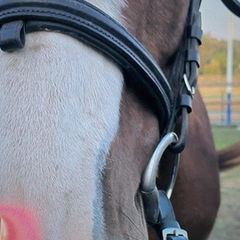
Tap any area on the horse, or use the buttons below it.
Poll & Jaw
660nm-led (superficial tissue)About this area
The poll sits just behind the ears where the headpiece rests, with the jaw hinge and upper cervical joints directly beneath. Thin covering means light reaches the area quickly.
Common concerns
- Bridle and headpiece pressure
- Tension through the jaw hinge
- Resistance to flexing at the poll
Matching product
Equine Poll Cap
How to use
Fit over a clean, dry poll with the bridle off, so the cap sits flat against the crest.
Shop this area
Head
660nm-led (superficial tissue)About this area
The face, jawline and muzzle. Skin is thin and vasculature superficial here, so this is one of the few areas a handheld device can cover in a couple of minutes.
Common concerns
- Facial muscle tension
- Sensitivity along the jawline
- Head-shy behaviour when handled
Matching product
Handheld Red Light Therapy Torch
How to use
Never aim directly at the eyes — work from the side and keep the beam moving.
Shop this area
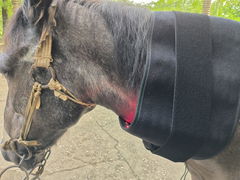
Neck
660nm + 850nm dualAbout this area
The C1-C7 cervical spine and the muscle running either side of the crest. This is the segment doing the work in every bend, flexion and downward stretch.
Common concerns
- Stiffness through one side of the crest
- Uneven bend left versus right
- Restricted downward stretch
Matching product
Equine Neck LED Device / Leg & Neck Wrap
How to use
Work in three passes along both sides of the crest — upper, middle, lower.
Shop this area
Shoulder & Withers
660nm + 850nm dualAbout this area
The withers and the shoulder blade beneath them — the first place saddle pressure concentrates, and the pivot for every stride of the front limb.
Common concerns
- Pressure marks under the front of the saddle
- Shortened front-limb stride
- Muscle tension behind the withers
Matching product
Full-Body Equine Blanket
How to use
A full blanket covers withers and shoulder in one pass; spot-treating tends to miss the lower edge of the shoulder blade.
Shop this area
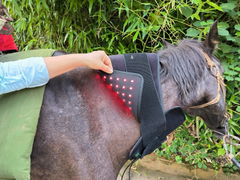
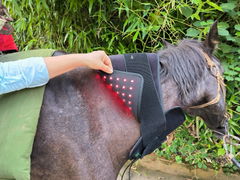
Back & Barrel
660nm + 850nm dualAbout this area
The thoracic spine, ribcage and the full saddle-bearing surface. The largest single area on the horse, and the one most often treated as a whole after work.
Common concerns
- Reluctance to lift through the back
- Pressure points along the saddle panel
- Sensitivity over the ribs
Matching product
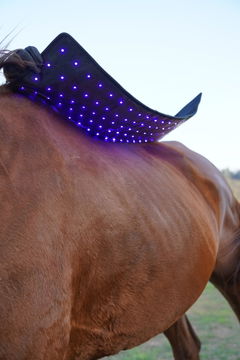
Infrared Back Pad for Horses
How to use
Girth the pad just firmly enough to sit flat — compression is not what does the work here.
Shop this area
Loin & Croup
850nm-led (deep tissue)About this area
The lumbar span behind the saddle and the croup above the sacroiliac joint — where the push from the hindquarters is transferred into the spine.
Common concerns
- Tension across the loin
- Asymmetry through the croup
- Reduced engagement behind the saddle
Matching product
Infrared Back Pad / Full-Body Blanket
How to use
Position the pad's rear edge behind the last rib, otherwise the loin is not actually covered.
Shop this area
Hindquarters
850nm-led (deep musculature)About this area
Gluteals, hamstring group and the deep muscle over the hip. The thickest muscle mass on the horse, and the source of forward power.
Common concerns
- Loss of drive from behind
- Shortened stride on one hind
- Tightness over the hip
Matching product
Full-Body Equine Blanket
How to use
Deep muscle here — 850nm near-infrared reaches further than 660nm. Typically used after work rather than before.
Shop this area
Legs & Hocks
850nm-led (joints, tendons & ligaments)About this area
Knees and hocks, cannon bones, fetlocks, flexor tendons and suspensory ligaments. The hock is hind-limb only — the front limb's equivalent joint is the knee, and the two behave quite differently.
Common concerns
- Filled tendon sheaths
- Warm or puffy fetlocks
- Stocking up after transport
Matching product
Hock Wraps & Leg Boots
How to use
Snug but never tight. Boots run on both fronts or both hinds together; the wrap suits a single hock or knee.
Shop this area
Hooves
850nm-led (through the hoof wall)About this area
Hoof wall, coronary band, frog and sole. The coronary band is where new horn originates, so it is the ring most worth covering.
Common concerns
- Coronary band sensitivity
- Slow hoof wall growth
- Discomfort after shoeing
Matching product
Red Light Therapy Hoof Boots
How to use
Pick out the sole first so the boot seats properly and the light sits close to the coronary band.
Shop this area