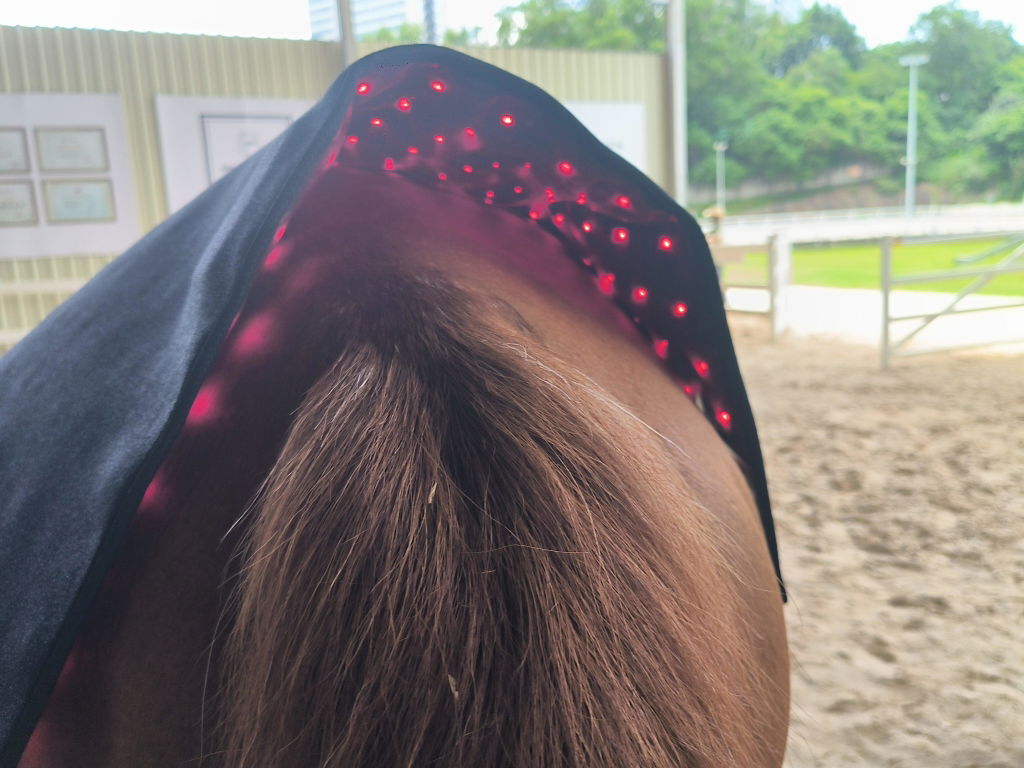
Red Light Therapy for Horses with PSSM or Tying-Up: What a Light Can't Change
Share
⚠️ If your horse is tying up right now — stiff, sweating, reluctant or unable to move — stop reading and call your veterinarian. Do not force him to move. Severe episodes can cause irreversible kidney damage. This page is for afterwards.
PSSM is the diagnosis that makes owners feel powerless. Your horse looks fine standing in the field. Then he works, and he locks up — hard, sweating, refusing to move — and there's nothing in your grooming kit that touches it.
So it's understandable to wonder whether red light therapy might help. Here's our honest answer, and it's not a hedge: PSSM is a defect in how muscle cells store and use energy. A light doesn't change that.
But there's a better version of this story than "no." Because PSSM is genuinely manageable — just not with equipment. The tools that work are the feed bucket and the calendar, and this guide explains exactly why.
The Short Answer
Red light therapy cannot treat PSSM. In type 1 PSSM, a mutation in the GYS1 gene makes an enzyme more active than it should be, so muscle packs away abnormal amounts of glycogen — and then can't access it during exercise, leaving the cells in an energy deficit. Light does not change a gene, and it does not change glycogen metabolism.
The genuinely good news: there is no cure for PSSM, but most affected horses can be managed successfully through diet and exercise. That's not a consolation prize — that's the treatment, and it works. During an acute tying-up episode, a device is the wrong instinct entirely: that's a vet call, because kidney damage is on the table.
What PSSM Actually Is — the Paradox at the Heart of It
Polysaccharide storage myopathy causes abnormal accumulation of glycogen — the stored form of sugar — in muscle. Affected horses carry roughly 1.8 times more glycogen in their muscles than normal.
Now here's the part that surprises people. You'd think extra fuel in the tank would be an advantage. It's the opposite:
The tank is full. The horse can't reach it.
In PSSM1, the defective GYS1 gene makes the glycogen synthase enzyme more active than normal — taking up more glucose after a meal and packaging more glycogen into muscle cells. The muscle keeps making and storing glycogen abnormally.
But during exercise, the horse cannot access that extra glycogen for energy. The muscle cells enter an energy deficit state — a full tank with no working pump. That deficit is what produces tying up.
Read that again, because it explains everything downstream: this is a metabolic plumbing fault, not a sore muscle. Nothing you apply to the outside of the horse reroutes it.
The clinical result is episodes of muscle stiffness and pain after exercise — tying up, properly called exertional rhabdomyolysis — with reluctance to move, sweating, lameness and muscle tremors.
PSSM1 vs PSSM2 — and a Warning About the Tests
| PSSM1 | PSSM2 | |
|---|---|---|
| Cause | Known mutation in the GYS1 gene | Unknown — may also be genetic |
| Inheritance | Autosomal dominant — one defective copy is enough | Not established |
| Diagnosis | DNA test on hair or blood | Muscle biopsy — with caveats |
| Validated test? | Yes | No — see below |
⚠️ The PSSM2 genetic tests you can buy are not validated
There is currently no scientifically validated, peer-reviewed diagnostic test for PSSM2 or for myofibrillar myopathy (MFM).
More specifically: a recent study did not find a significant association between the commercial genetic test variants marketed as P2, P3 (a and b) and P4, and horses diagnosed with PSSM2 or MFM based on histopathology — histopathology being the gold standard for evaluating muscle disease.
We're a company that sells horse products, and we're telling you this because it's the same principle as everything else on this page: if you're being sold a PSSM2 genetic panel, talk to your vet before you spend the money. Currently the best way to identify PSSM2 is muscle biopsy.
Not All Tying-Up Is PSSM
This matters before you commit to a management plan built for the wrong disease.
There are other causes for tying-up besides PSSM — including malignant hyperthermia, glycogen branching enzyme deficiency, and myosin heavy chain myopathy — and it's important to rule these out so the horse is treated appropriately. Myofibrillar myopathy (MFM) is another picture again, characterised by exercise intolerance.
Breed matters more than you'd expect
Thoroughbreds, Arabians and Standardbreds do not have the GYS1 mutation that causes PSSM1 — so if your Thoroughbred ties up, PSSM1 isn't the answer, and something else is going on. PSSM1 is found in breeds descending from the continental Belgian breed: Percherons, Belgian drafts and their crosses, Appaloosas, Paints, Morgans, Tennessee Walkers, Warmbloods and others.
That 21% figure from the UK tells you plainly: biopsy-diagnosed PSSM is not the same population as GYS1-positive PSSM. Which is precisely why the two types were separated in the first place.
An Acute Episode Is a Vet Call — Not a Device Moment
⚠️ What's actually at stake
An episode causes significant pain: stiff, firm muscles, profuse sweating, reluctance to move. In severe cases the horse is unable to rise to stand. In draft horses, the primary sign can be profound weakness.
And here's the reason this isn't something to manage yourself: in a severe episode, intravenous fluids may be required to help flush out the muscle proteins released from damaged muscle cells — because these are excreted through the kidneys and can cause irreversible damage there.
Irreversible. That's the word that ends the debate about reaching for anything other than a phone.
What veterinary treatment actually looks like:
- Stall rest during the episode — do not force the horse to move.
- Anti-inflammatory pain medication, prescribed by your vet.
- Intravenous fluids in severe episodes, to protect the kidneys.
- Muscle relaxants and sedation may be given to help recovery.
- Hay only — no grain during this period.
Note what isn't on that list. Not because we're being cautious for the sake of it — because none of it is what a tying-up horse needs in that hour.
What Actually Manages PSSM
Here's where the story turns genuinely hopeful. The management recommendations are well established and they aim at three things: reducing muscle glycogen synthesis, promoting oxidative metabolism, and providing fat as an alternative fuel.
The diet
Forage first, low in sugar and starch, with additional calories coming from fat or soluble fibre rather than grain. The research is blunt about why this isn't optional: affected horses showed persistent elevations in muscle enzymes with exercise unless fed a low starch, high fat diet. The diet isn't supportive care — it's the mechanism of control.
The exercise
Consistent daily exercise is not a nice-to-have. It's half the treatment, and it's the half most often lost to weather, work schedules and good intentions.
The details
Supplements such as vitamin E, selenium and acetyl-L-carnitine may support muscle metabolism. And a caution: the nutritional needs of a PSSM horse can easily become quite complicated, so working with a certified equine nutritionist is genuinely worth it. Note too that warmbloods with myofibrillar myopathy are managed differently from classic tying-up horses — another reason the diagnosis has to be right first.
The payoff: early diagnosis and disciplined management enable most horses with PSSM1 to maintain health and return to performance. No cure — but a working life. That's what's on offer, and it's earned in the feed room, not the tack shop.
So Where Does Red Light Therapy Fit?
Honestly: nowhere near the centre of this.
It does not change the GYS1 gene. It does not change how much glycogen the muscle packs away, and it does not restore the horse's ability to access it during work. The energy deficit is a metabolic fault — the thing that fixes the fuel supply is the fat in the diet, and the thing that keeps the muscle adapted is the daily work.
And in an acute episode it's actively the wrong reflex, for the reason above: irreversible kidney damage is a real risk and the horse needs a vet, fluids and medication, not a pad.
The one narrow possibility
Between episodes, in a horse whose diagnosis is established and whose diet and exercise programme is running properly, if your vet believes comfort support in the muscle has a small place, that's their call to make about your horse. It's a marginal role at the edge of a management plan — not part of the plan itself. Anyone selling you a device as a PSSM solution is selling you something that cannot work.
For general post-work muscle support in horses without a metabolic myopathy — a different question entirely — see our guide to red light therapy for horse muscle recovery. And because PSSM is one of the conditions that can leave a horse unable to build muscle over the back, our guide to what actually builds your horse's topline covers why the underlying condition has to be addressed first.
Conclusion: The Full Tank Nobody Can Reach
PSSM is a muscle that has stored 1.8 times the normal glycogen and cannot use it — a full tank with a broken pump, leaving the cells in an energy deficit that surfaces as tying up. It's genetic in type 1, of unknown cause in type 2, and the commercial PSSM2 tests aren't scientifically validated. There is no cure.
None of that is changed by light. What is changed — reliably, and by you — is the diet and the routine: under 20% of energy from sugar and starch, 15–25% from fat, forage first, and regular daily exercise. Do that properly, with your vet and a nutritionist, and most PSSM1 horses maintain health and return to performance.
That's a better outcome than any device could promise, and it's real. We'd rather point you at the feed room than sell you something that can't help. If your vet later thinks a modest comfort role exists between episodes, the PbmEquine equine range will be here — for that job, and no bigger one.
Frequently Asked Questions
Can red light therapy help a horse with PSSM or tying-up?
Not in any way that addresses the problem. PSSM — polysaccharide storage myopathy — is a disorder of how muscle cells store and access energy. In type 1, a mutation in the GYS1 gene makes the glycogen synthase enzyme more active than normal, so the muscle packs away abnormal amounts of glycogen and then cannot access it properly during exercise, leaving the muscle cells in an energy deficit. Light does not change a gene, and it does not change muscle glycogen metabolism. There is no cure for PSSM, but most affected horses can be managed successfully through diet and exercise — and that is the treatment: a low starch, low sugar, higher fat diet and regular daily exercise. During an acute tying-up episode, a device is actively the wrong instinct: that is a veterinary situation. At most, red light therapy might play a small comfort-support role between episodes if your vet, who knows the case, thinks it useful. It changes nothing about the underlying condition.
What is PSSM in horses?
Polysaccharide storage myopathy is a muscle disorder that causes abnormal accumulation of glycogen — the stored form of sugar — in muscle. Affected horses have roughly 1.8 times more glycogen in their muscles than normal, yet paradoxically they cannot access the extra energy when they exercise, so muscle cells enter an energy deficit state. The result is episodes of muscle stiffness and pain after exercise, known as tying up or exertional rhabdomyolysis, with reluctance to move, sweating, lameness and muscle tremors. In type 1 PSSM, a mutation in the glycogen synthase 1 (GYS1) gene makes the enzyme more active than normal, taking up more glucose after a meal and packaging more glycogen into muscle cells. It follows an autosomal dominant pattern — a horse needs only one defective copy to be affected. There is no cure, but most affected horses can be managed successfully through diet and exercise.
What is the difference between PSSM1 and PSSM2?
PSSM1 is caused by a known genetic mutation in the GYS1 gene, and a validated DNA test on hair or blood confirms it. PSSM2 refers to horses that show abnormal muscle glycogen on biopsy but do not have the GYS1 mutation — and the cause or causes of PSSM2 remain unknown. This matters practically: there is currently no scientifically validated, peer-reviewed diagnostic test for PSSM2 or for myofibrillar myopathy (MFM). A recent study found no significant association between the commercial genetic test variants marketed as P2, P3(a and b) and P4 and horses diagnosed with PSSM2 or MFM on histopathology, which is the gold standard for evaluating muscle disease. Currently the best way to identify PSSM2 is muscle biopsy, with caveats. If you are being sold a PSSM2 genetic panel, discuss it with your vet before spending money on it.
What should I do if my horse is tying up right now?
Stop, do not force the horse to move, and call your veterinarian. An acute episode causes significant pain, with stiff firm muscles, profuse sweating and reluctance to move; in severe cases a horse may be unable to rise, and in draft horses the leading sign can be profound weakness. This needs veterinary treatment, not home remedies. Horses are typically placed on stall rest during the episode and given anti-inflammatory pain medication. In a severe episode intravenous fluids may be required to help flush out the muscle proteins released from damaged muscle cells, because these are excreted through the kidneys and can cause irreversible damage there. Muscle relaxants and sedation may also be used. During this period horses should be fed only hay and no grain. Reaching for any device instead of the phone is the wrong instinct here — kidney damage is a real and permanent risk.
What actually manages PSSM in horses?
Diet and exercise, applied with discipline and consistency. Management aims to reduce muscle glycogen synthesis, promote oxidative metabolism, and provide fat as an alternative fuel. The standard recommendation is a diet providing less than 20% of digestible energy as nonstructural carbohydrate (sugar and starch), 15 to 25% of digestible energy as fat, and regular daily exercise. Forage comes first, with additional calories from fat or soluble fibre rather than grain. Research showed persistent elevations in muscle enzymes with exercise unless horses were fed a low starch, high fat diet. Supplements such as vitamin E, selenium and acetyl-L-carnitine may support muscle metabolism. Because PSSM nutrition gets complicated quickly, working with a certified equine nutritionist is worthwhile, and note that warmbloods with myofibrillar myopathy are managed differently. Early diagnosis and disciplined management let most PSSM1 horses maintain health and return to performance.