Why Horse-Specific Red Light Therapy Devices Matter: Complete Engineering Comparison
Share
Engineering Comparison · Why Equine Devices Are Built Differently
A detailed engineering comparison of horse-specific red light therapy devices versus human RLT panels — covering the five critical dimensions where equine devices are deliberately engineered differently (size, durability, power density, ergonomics, multi-animal compatibility), the barn environment challenges that destroy unprepared electronics, the skin and coat thickness reality that demands higher therapeutic power, and the honest assessment of when human devices can be adequate substitutes versus when equine engineering genuinely matters for your horse's care.
"Can I just use my own red light therapy panel on my horse?" It's one of the most common questions horse owners ask when discovering photobiomodulation therapy — and a reasonable question on the surface. After all, the cellular biology of photobiomodulation works identically across species: the same wavelengths activating the same mitochondrial pathways producing the same therapeutic effects in human and equine tissue. So why do horse-specific devices exist at all if the underlying science is identical?
The answer lies in the substantial engineering differences between devices designed for human use in bedrooms and bathrooms versus devices designed for equine use in barns, paddocks, and trailers. Same therapeutic wavelengths. Same biological mechanisms. Dramatically different practical engineering requirements. This guide walks through the five critical dimensions where horse-specific red light therapy devices are deliberately engineered differently from their human counterparts — explaining why the price difference reflects real value rather than marketing markup, when human devices can serve adequately for occasional use, and why serious equine therapeutic programs benefit substantially from purpose-built equipment.
The Cellular Biology Is Identical — The Engineering Requirements Are Not
Both human and equine red light therapy devices use the same therapeutic wavelengths (660 nm + 810-850 nm dual-wavelength), activate the same cellular mechanisms (cytochrome c oxidase in mitochondria), and produce the same downstream biological effects (increased ATP, nitric oxide release, inflammatory modulation). What differs entirely is the practical engineering surrounding these identical cellular foundations: coverage area sized for radically different body masses, durability built for radically different use environments, power density calibrated for radically different tissue depths, ergonomic shapes matched to radically different anatomies, and safety considerations addressing radically different application scenarios. Understanding these engineering differences explains why horse-specific devices exist and when their additional cost is justified.
dimensions differ
vs human
by body region
(identical therapy)
Setting the Foundation: What's Actually the Same Across Species
Before diving into the engineering differences, it's important to acknowledge what genuinely doesn't differ between human and equine red light therapy applications. The therapeutic wavelengths are identical — both species respond optimally to 660 nm red light combined with 810-850 nm near-infrared. The cellular mechanisms are identical — photons absorbed by cytochrome c oxidase in mitochondria trigger the same downstream effects (ATP production, nitric oxide release, inflammatory modulation) in horse cells as in human cells. The treatment principles are identical — consistency, appropriate session duration, adequate dosing all matter the same way across species.
This shared scientific foundation matters because it justifies extending photobiomodulation from human medicine to equine medicine without requiring fundamentally different science. The dramatic improvements horse owners report from red light therapy for horses aren't because horses respond to magically different wavelengths than humans — they're because the same proven cellular effects deliver meaningful therapeutic benefit in equine tissue just as they do in human tissue. Owners exploring options across the range of red light therapy for horses are accessing the same fundamental therapy that supports human wellness applications, simply engineered for the practical realities of equine care.
But this is precisely where the engineering differences become important. The science being identical doesn't mean the practical devices should be identical. A car engine designed to power a sedan and one designed to power a tractor both run on the same combustion principles, but no rational person would expect them to be interchangeable. The same principle applies to red light therapy devices — identical underlying science, dramatically different practical applications, dramatically different engineering requirements.
The 5 Critical Engineering Dimensions Where Equine Devices Differ
Five specific engineering dimensions distinguish horse-specific red light therapy devices from human devices. Each represents real practical considerations that affect therapeutic effectiveness, device longevity, and overall value when red light therapy for horses is applied in barn environments to large athletic animals. The cards below detail each dimension with direct human-versus-equine comparison.
Size and Coverage Area
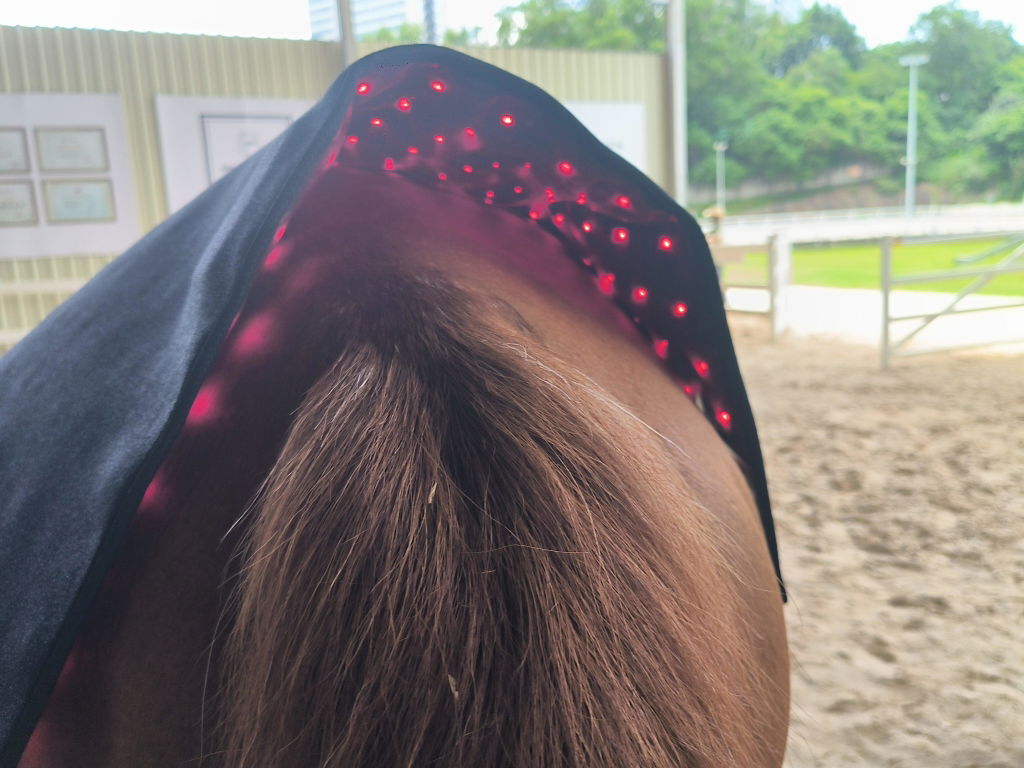
Why a small panel can't efficiently treat a 1,200-pound animalA typical human-targeted red light therapy panel covers approximately 30 × 60 cm — designed to treat focused areas of human skin and tissue with reasonable efficiency. A horse, however, has a body surface area roughly 6-8 times larger than a human. The implications are direct: treating one side of a horse's back with a 30 × 60 cm human panel requires 4-6 sequential repositioning sessions of 15-20 minutes each — totaling 60-120 minutes of active management for partial treatment of a single body region. Equine devices are sized for the proportional reality: hand-held devices for focused spot treatment, larger pads and wraps for body regions, and full equine blankets covering substantial body areas in single sessions.
Panel typically 30 × 60 cm. Designed for focused human applications (face, joint, specific muscle group). One side of horse back requires 4-6 sequential 15-minute sessions = 60-90 min total.
Sized proportionally — full equine blankets covering one entire side of the body in single sessions. Hand-held devices for spot work. Pads for legs sized for actual leg coverage. Same treatment area in 15-30 minutes total.
Size differences aren't marketing — they reflect 6-8x body mass differences requiring proportional device scaling. Equine devices deliver practical session efficiency that human devices cannot achieve on horse-sized animals.
Durability and Barn Environment Resistance
What barns actually do to electronicsHuman red light therapy devices are designed for bedroom, bathroom, or living room use — climate-controlled environments where the device sits on a stand or hangs on a wall, untouched by environmental hazards. Equine devices live a fundamentally different operational life. Barns expose electronics to dust accumulation, moisture from washing and humidity, temperature extremes from -10°C winter barns to 40°C+ summer storage, trampling risk from loose horses, splashing from water buckets and grooming, chemical exposure from leather cleaners and fly sprays, and vibration from trailer transportation. Devices not engineered for these conditions degrade rapidly — failing within 6-18 months in serious barn use versus the 5-10 year operational life of properly engineered equine devices.
Built for climate-controlled indoor use. Plastic housing, exposed connectors, sensitivity to dust and moisture. Designed assumption: gentle handling, dry conditions, room temperature.
Ruggedized construction with sealed housings, reinforced cables, dust-resistant connectors, washable surfaces, wider operating temperature range. Designed assumption: barn conditions, occasional drops, exposure to dust/moisture/chemicals.
Durability engineering is the single largest contributor to total cost of ownership. A $400 human device failing within 18 months delivers worse value than a $1,200 equine device lasting 8 years — and barn conditions reliably accelerate human device failure.
The detailed evaluation framework for selecting properly engineered equine devices builds on these durability considerations alongside other quality factors. Owners working through device selection benefit from understanding the comprehensive framework covered in the best red light therapy for horses buyer's guide, which provides the seven-dimension evaluation framework essential for distinguishing genuinely barn-ready equine devices from human devices marketed adapted for animal use.
Power Density and Penetration
Why equine devices need higher power outputRed light therapy works through light penetrating tissue and triggering cellular responses. The therapeutic effect depends on adequate photon density reaching target structures — and reaching those structures requires penetrating skin, coat, and intervening tissue. Horses have substantially thicker tissue between the light source and target structures than humans: skin 1.5-7mm thick depending on body region, coat 1-3 cm depending on season, often substantial subcutaneous fat layers, and deeper underlying tissue masses. Equine devices typically deliver higher power density (30-100 mW/cm² for serious therapeutic devices) to ensure adequate photon delivery to target depths within practical session times. Human devices calibrated for thinner human tissue may not deliver therapeutic doses to deeper equine structures in reasonable session durations.
Power density typically 20-50 mW/cm² calibrated for human tissue thickness. Adequate for surface skin applications and superficial tissue on humans. May require extended session times (30-60+ min) to deliver therapeutic doses to deeper equine structures.
Power density typically 30-100 mW/cm² calibrated for equine tissue thickness. Designed to deliver therapeutic doses through horse skin and coat in 15-20 minute sessions. Higher power output engineered for the practical reality of horse anatomy.
Power density differences aren't trivial — they determine whether therapeutic doses actually reach target tissue in practical session times. Underpowered devices may produce minimal therapeutic effect on horses regardless of how diligently they're applied.
Ergonomic Form Factor
Why flat panels can't wrap curved equine anatomyEquine anatomy is fundamentally curved — legs, hocks, knees, fetlocks, and the curved surface of the topline all require devices that conform to the body's natural shape rather than imposing flat-panel geometry against curved tissue. Human red light therapy panels are uniformly flat because human applications typically involve sitting or lying near a panel for whole-body or focused-area exposure. This works for humans but creates poor contact with curved equine surfaces — most of the therapeutic light reflects off or misses the target tissue when flat panels are positioned against curved body areas. Equine devices are engineered with flexible pads, leg wraps, and blanket-style forms specifically designed to conform to equine anatomy, ensuring optimal photon delivery to target tissues.
Flat rigid panels. Designed for humans sitting/standing at distance. Poor conformation to curved equine surfaces. Significant light loss when attempting to wrap legs, hocks, knees, or other curved areas.
Flexible pads, leg wraps with strap systems, hock-specific wrap designs, full blankets contoured to equine topline. Designed to conform to curved equine anatomy ensuring optimal photon delivery.
Form factor isn't cosmetic — it directly affects how much therapeutic light actually reaches target tissue. A flexible equine wrap delivering 80% of light to target tissue outperforms a flat human panel delivering 30% of light to the same target.
Multi-Animal Compatibility
Why properly engineered equine devices work across speciesA well-engineered horse-specific red light therapy device typically works excellently on dogs, cats, and other animals with simple session duration adjustments — but the reverse isn't equally true. Human devices, designed solely for human applications, often lack the durability, power density, and form factor flexibility needed for diverse animal use. The same equine device that serves a horse for back maintenance can serve a dog for senior joint comfort and a barn cat for old-age wellness, providing multi-species value that human devices cannot deliver. Many owners value this flexibility highly — the same investment supports multiple family animals across their entire household.
Designed for human applications only. Form factors, durability, and power density not optimized for animal use. May work in limited applications but not optimal for serious multi-species therapy.
Engineered with multi-animal use as core design requirement. Same device works on horse, dog, cat with session duration adjustments. One device serves entire household animals — better value over time.
Multi-animal compatibility reflects intentional engineering — properly designed equine devices serve diverse animal needs because their fundamental engineering accommodates animal-care realities. Human devices typically cannot match this versatility.
The Barn Environment Reality: 6 Hazards Human Devices Weren't Built For
Understanding why durability engineering matters so much for red light therapy for horses requires understanding what barns actually do to electronics. The six hazards below routinely destroy devices not engineered for barn use — and they're why equine engineering investment matters more than human-device pricing comparisons suggest.
6 Barn Conditions That Routinely Damage Human RLT Devices
These conditions exist in virtually every working barn. Human devices designed for bedroom or living room use cannot reliably survive long-term exposure to all six factors simultaneously.
Hay dust, shavings dust, dried mud accumulating in vents, connectors, and around LED panels — causes overheating and electrical issues over time.
Washing horses, splashing water buckets, sweat, humidity in indoor arenas, condensation when bringing cold devices into warm barns — damages non-waterproof electronics.
Loose horses, dropped devices, accidental kicks during use, devices left on stall floors — physical damage to non-ruggedized housings.
Winter barns dropping to -10°C, summer storage reaching 40°C+, temperature swings stressing electronic components and battery systems not designed for the range.
Leather cleaners, fly sprays, dewormers, barn cleaning products — damages device surfaces, seals, and exposed components.
Trailer transportation, dropping during use, storage in tack trunks — cumulative mechanical stress that fails components over time.
Skin and Tissue Depth: Why Equine Power Density Must Be Higher
The technical justification for higher equine device power density becomes clear when comparing actual tissue thickness across body regions in both species. The table below presents the comparative anatomy that drives the engineering decisions behind effective red light therapy for horses across diverse body regions.
Tissue Thickness Comparison: Human vs Equine Body Regions
Approximate values for typical adults / mature horses.
| Body Region | Human Skin Thickness | Equine Skin Thickness | Equine Coat Layer |
|---|---|---|---|
| Face / Head | 0.5-1 mm | 1.5-2 mm | 5-15 mm |
| Neck | 1-1.5 mm | 2-4 mm | 10-25 mm |
| Trunk / Back | 1.5-2.5 mm | 4-5 mm | 10-25 mm |
| Shoulder | 1.5-2 mm | 4-5 mm | 10-20 mm |
| Hindquarters / Croup | 2-3 mm | 5-7 mm | 10-25 mm |
| Legs | 1-1.5 mm | 2-3 mm | 5-15 mm |
The implications are direct: in every body region, equine tissue presents 2-3 times more thickness for therapeutic light to penetrate than equivalent human regions, before even considering the substantial coat layer that adds another 10-25 mm of attenuation. The deeper penetration requirement explains why equine devices typically specify higher power density than human devices — the same therapeutic doses delivered to deeper structures require correspondingly higher output. Understanding how light therapy fundamentally works through tissue depth aligns with the wavelength science covered in red light therapy vs infrared therapy for horses — the dual-wavelength gold standard (660 nm + 850 nm) addresses both surface and deep tissue applications, with equine devices specifically calibrated to deliver therapeutic doses through the additional tissue thickness equine anatomy presents.
What Defines a Properly Engineered Equine RLT Device
A well-engineered horse-specific red light therapy device integrates the five engineering dimensions into a coherent product designed for the realities of equine therapeutic use. The features below characterize quality equine engineering — verifying these characteristics filters most genuinely engineered equine devices from human devices marketed adapted for animal use.
Dual-wavelength 660 nm + 810-850 nm — same as quality human devices
30-100 mW/cm² — calibrated for equine tissue depth
Form factor matched to equine body proportions and treatment areas
Ruggedized for barn dust, moisture, temperature extremes
Flexible conformation to curved equine anatomy
Low electromagnetic field exposure for animal welfare
Same device works on horses, dogs, cats with adjusted protocols
Hands-free secure application during longer sessions
12-24+ months reflecting confidence in barn-durability
When Human Devices Can Work Adequately for Horses
After working through five engineering dimensions and the barn environment realities, an honest assessment recognizes that human red light therapy devices can serve adequately in specific limited contexts: occasional supplementary use on a calm, accommodating horse in controlled indoor conditions (clean tack room rather than active stall); small focal applications where size limitations don't dramatically affect session times; situations where the owner doesn't mind extended session times for full coverage; budget-constrained situations where any RLT is better than no RLT. The honest cases where horse-specific devices genuinely outperform: serious therapeutic programs requiring consistent application, regular barn use with the environmental hazards covered above, large-area treatment needs (back, topline, full body) where coverage area matters significantly, owners with limited time per session, and long-term ownership where total cost of ownership over 5-10 years favors purpose-built engineering. The decision isn't about which device is universally better — it's about matching device engineering to your specific use case realities.
Why the Price Difference Reflects Real Engineering Investment
Horse-specific red light therapy devices typically cost meaningfully more than equivalent-power human devices — sometimes 1.5 to 3 times more for comparable wavelength and power specifications. Understanding what justifies this price difference helps owners evaluate whether the additional investment delivers genuine value for their situation.
Larger coverage area directly increases manufacturing costs. Equine devices require more LED diodes, more printed circuit board material, larger housings, more comprehensive electrical infrastructure, more substantial power supplies, and more material throughout the product. A device with 2-3 times the coverage area legitimately costs 2-3 times more to manufacture even when the per-component costs are identical. Marketing markup is real in some categories but coverage area is one factor where the price difference reflects actual material costs.
Ruggedized construction adds substantial manufacturing cost. Sealed housings, reinforced cable connections, dust-resistant connectors, impact-resistant materials, and wider operating temperature components all cost more than the consumer-grade alternatives used in indoor human devices. The engineering investment in barn-proof construction translates directly to longer device life in actual use — but the upfront cost difference reflects this real engineering investment.
Higher power density requires more sophisticated LED arrays and more comprehensive thermal management to maintain therapeutic output without overheating during longer sessions or sustained use. Higher-output LEDs cost more individually, and the cooling systems needed to manage their heat output add further cost. This is engineering investment in actual therapeutic capability rather than premium markup.
Custom ergonomic form factors require specialized tooling and assembly processes that don't exist for standard flat panels. Curved pads, leg wraps with strap systems, blanket forms with body-conforming shapes all involve manufacturing processes specifically developed for these forms. The tooling costs amortize across smaller production volumes than mass-market human devices, contributing to per-unit cost differences.
Regulatory and safety certifications for veterinary device classification often require additional testing, documentation, and compliance work beyond what consumer human devices need. Multi-animal safety verification, equine welfare considerations, and veterinary practice integration all add to the development cost base that equine devices recover through their pricing.
The full breakdown of these engineering and quality factors aligns with comprehensive device evaluation frameworks. For owners building a complete picture of how device characteristics matter for therapeutic value, exploring the detailed comparison between LED-based and laser-based therapeutic technologies in red light therapy vs cold laser for horses provides additional context for understanding why purpose-built equine devices represent genuine engineering investment rather than marketing-driven pricing.
Practical Decision: Is a Horse-Specific Device Worth It for You?
The practical question for most owners isn't whether horse-specific devices are theoretically better — they clearly are, across the five engineering dimensions covered above. The practical question is whether the additional investment delivers value for your specific use case when applying red light therapy for horses to your particular situation. The decision framework below helps you assess this for your situation.
Frequency of use is the most important single factor. Occasional supplementary use (once or twice monthly for general wellness) doesn't necessarily justify equine-specific engineering — a human device may serve adequately. Regular therapeutic use (multiple times weekly, daily during active healing periods) strongly favors equine engineering because the durability, power density, and form factor differences compound over hundreds of sessions. If you'll use the device frequently, equine engineering delivers proportionally more value over time.
Body areas to be treated affect form factor needs significantly. Spot treatment of small areas (specific wounds, fetlock soreness, focused joint applications) works adequately with hand-held devices regardless of whether they're equine-engineered or adapted human devices. Larger area treatment (back, topline, whole hindquarters, multiple legs) strongly favors equine pads, wraps, or blanket forms over flat human panels — the time difference for comprehensive coverage is substantial.
Barn environment conditions affect durability requirements. Indoor controlled-condition use (clean tack room, climate-controlled training facility) reduces durability demands and allows human devices to last reasonably well. Active barn use (working stall environments, occasional outdoor use, trailer-transport for clinics or shows) substantially favors ruggedized equine engineering — human devices fail much faster in these conditions.
Investment timeline affects the value calculation. Short-term use planning (1-2 years for specific recovery program) may not justify equine engineering premium because the durability advantages don't fully amortize. Long-term use planning (5-10+ years of regular use) strongly favors equine engineering — total cost of ownership over a decade clearly favors purpose-built devices over adapted human devices requiring frequent replacement.
Discover Red Light Therapy Devices Engineered Specifically for Equine Use
PbmEquine devices are designed from the ground up for the practical realities of equine therapeutic application — combining the same proven dual-wavelength specifications (660 nm + 810-850 nm) as quality human devices with the engineering investment that addresses size, durability, power density, ergonomic form factor, and multi-animal compatibility specifically. Every device features EMF-free certification, 12-month warranty, 30-day postage-paid returns, and barn-ready construction designed for years of reliable use in working equestrian environments. Hand-held devices for spot treatment, pads and wraps for leg and joint applications, full equine blankets for whole-body therapy. Multi-animal devices supporting horses, dogs, and cats with the same engineering investment. Use code PBME10 for 10% off your first order — and invest in engineering designed for your horse's actual needs rather than adapted from human applications.
Frequently Asked Questions About Horse-Specific Red Light Therapy Devices
Can I use a human red light therapy device on my horse?
Technically yes, but results are typically suboptimal across five critical dimensions. Size limitations: human panel 30×60 cm requires 30+ minutes of repositioning to treat one side of horse back vs 15-20 minutes with equine devices. Durability shortfalls: human devices not built for barn environments (dust, moisture, drops, temperatures from -10°C to 40°C). Power density typically calibrated for thinner human skin, may not penetrate equine skin (1.5-7mm) plus coat. Ergonomic form factor of flat panels doesn't conform to curved equine anatomy. For occasional supplementary use on calm horse in controlled conditions, human device may help; for serious therapeutic programs, horse-specific devices deliver substantially better results.
Why do horse-specific red light therapy devices cost more than human ones?
Five legitimate engineering reasons. (1) Larger coverage area requires more LEDs, PCB material, housing, electrical infrastructure — directly increases manufacturing costs. (2) Ruggedized construction for barn environments uses higher-grade materials, sealed housings, reinforced cables, impact-resistant components. (3) Higher power density requires more powerful LED arrays and sophisticated thermal management. (4) Ergonomic form factors (curved pads, leg wraps, blankets) require custom tooling and specialized assembly. (5) Veterinary device certifications often involve additional testing and documentation. Price difference reflects genuine engineering investment, not marketing markup — premium equine devices deliver substantially more functional value per dollar than budget human devices adapted for equine use.
Is it safe to use a human red light therapy panel on a horse?
Generally safe in biological terms — photobiomodulation mechanisms work identically across species (cytochrome c oxidase activation operates the same in human and equine cells). Practical safety issues from application factors: human devices in barn face damage risk from drops/kicks/splashing; cable management around large animals creates electrical safety concerns; flat panels can fall on horses if not secured; longer session times for inadequate coverage increase accident chance; horses may not tolerate awkward positioning required. Equine devices designed with these factors as core requirements. For occasional brief applications, human devices pose minimal risk; for regular therapeutic programs, equine devices offer meaningfully better practical safety.
What's the difference between human and equine red light therapy wavelengths?
Therapeutic wavelengths are identical — both use 660 nm red + 810-850 nm near-infrared dual-wavelength gold standard. Photobiomodulation works through same cellular mechanisms across species: cytochrome c oxidase activation, increased ATP production, nitric oxide release, inflammatory cytokine modulation occur identically in human and equine tissue. Differences aren't wavelength choice — they're power density (higher for equine to penetrate thicker tissue), coverage area (larger for equine to cover proportional body areas), form factor (curved wrapping vs flat panels), durability engineering (barn-proof vs bedroom-suitable). Quality equine devices use same proven 660 + 850 nm specifications as quality human devices — engineered differently around same therapeutic wavelengths.
Do I need a horse-specific red light therapy device?
Depends on use case. For occasional supplementary therapy on calm horse in good conditions where extended session times acceptable, human device may serve. For serious therapeutic programs — injury rehab requiring daily application, athletic recovery, chronic condition management, multi-horse facility, barn-based therapy with environmental exposure — horse-specific devices deliver substantially better results. Decision factors: weekly use frequency (frequent favors equine), body areas treated (large areas favor equine), barn conditions (rough conditions favor equine), time per session (limited time favors equine), investment timeline (5-10 year lifespan favors equine engineering). Most regular RLT users on horses find equine-specific devices deliver better long-term value.
How thick is horse skin compared to human skin?
Horse skin 1.5-7mm depending on body location; human skin averages 1.5-4mm — horse skin in thickest areas can be nearly twice human skin in equivalent areas. Variation by region: face 1.5-2 mm (thinnest), neck and trunk 2-4 mm, back and shoulder 4-5 mm (thicker for saddle support), hindquarter and croup 5-7 mm (thickest), legs 2-3 mm. Beyond skin, horses have substantial coat (1-3 cm depending on season/breed) and often subcutaneous fat further attenuating light penetration. Combined, therapeutic light must penetrate significantly more tissue mass before reaching target structures vs human applications, justifying higher power density specifications of properly engineered equine devices.
Can horse-specific red light therapy devices be used on dogs or cats?
Yes — well-engineered horse-specific devices typically work excellently on dogs and cats with simple session duration adjustments. Photobiomodulation mechanisms identical across mammalian species; same wavelengths (660 + 810-850 nm) activate same cellular pathways. Practical adjustments: shorter sessions for dogs (5-10 min vs 15-20 for horses) due to smaller tissue mass; smaller treatment areas addressed by hand-held devices and compact pads; lower total light exposure per session. Hand-held equine devices work seamlessly on dogs/cats; smaller equine pads/wraps fit larger dogs well; full equine blankets too large for dog/cat but smaller formats serve multi-species needs. Many horse owners with dogs appreciate multi-species value — supporting horse athletic recovery and dog joint comfort with same investment, something human-only devices don't provide.
What barn conditions can damage red light therapy devices?
Six barn factors create damage risk for non-ruggedized devices. Dust accumulation in vents and connectors causes overheating. Moisture from washing horses, splashing buckets, sweat, humidity, condensation damages non-waterproof electronics. Trampling risk from stall floors, loose horses, active areas. Temperature extremes from -10°C winter to 40°C+ summer stress components and batteries. Chemical exposure from leather cleaners, fly sprays, dewormers, barn cleaning products damages surfaces and seals. Vibration and physical impact from trailer transport, dropping, tack trunk storage creates cumulative mechanical stress. Properly engineered equine devices address all factors through ruggedized construction; human devices designed for bedroom use cannot reliably survive these conditions long-term.